
The Right Startup Operations

Many people ask me how a scientist ended up as an operations specialist. I tell them what drew me to biochemistry, as it turns out, was a fundamental interest in how tiny details had a tremendous influence on system success or failure. Just as a human is a collection of tiny components that somehow all work together to form a fully functional system; human built organizations are really just living systems made or broken by the tiniest details. That subtle tension between two people that somehow sets off organizational dysfunction. That one piece of paper that fails to reach its destination and causes a missed deal.
As I learned how to fix systems that were broken I became interested in how we designed the systems to avoid these pitfalls in the first place. This led me to startup operations. I deeply believe that building a company is different than what traditional operations teachings you find in your MBA program outline. Hiring your first operations role, as a result, isn’t about their experience working in large successful exits, or mature operating systems. It’s about what the person you hire knows about how to design those systems at the beginning. It’s about what this person knows about how to evolve those systems alongside your growth. It isn’t the same skillset. And the skillset is rarer than you think.
This is why I work fractionally.
To help as many organizations as I can with what I know about starting on the right foot, and growing at the right moment.
To understand my method, I’ll give you a metaphor from chemistry.
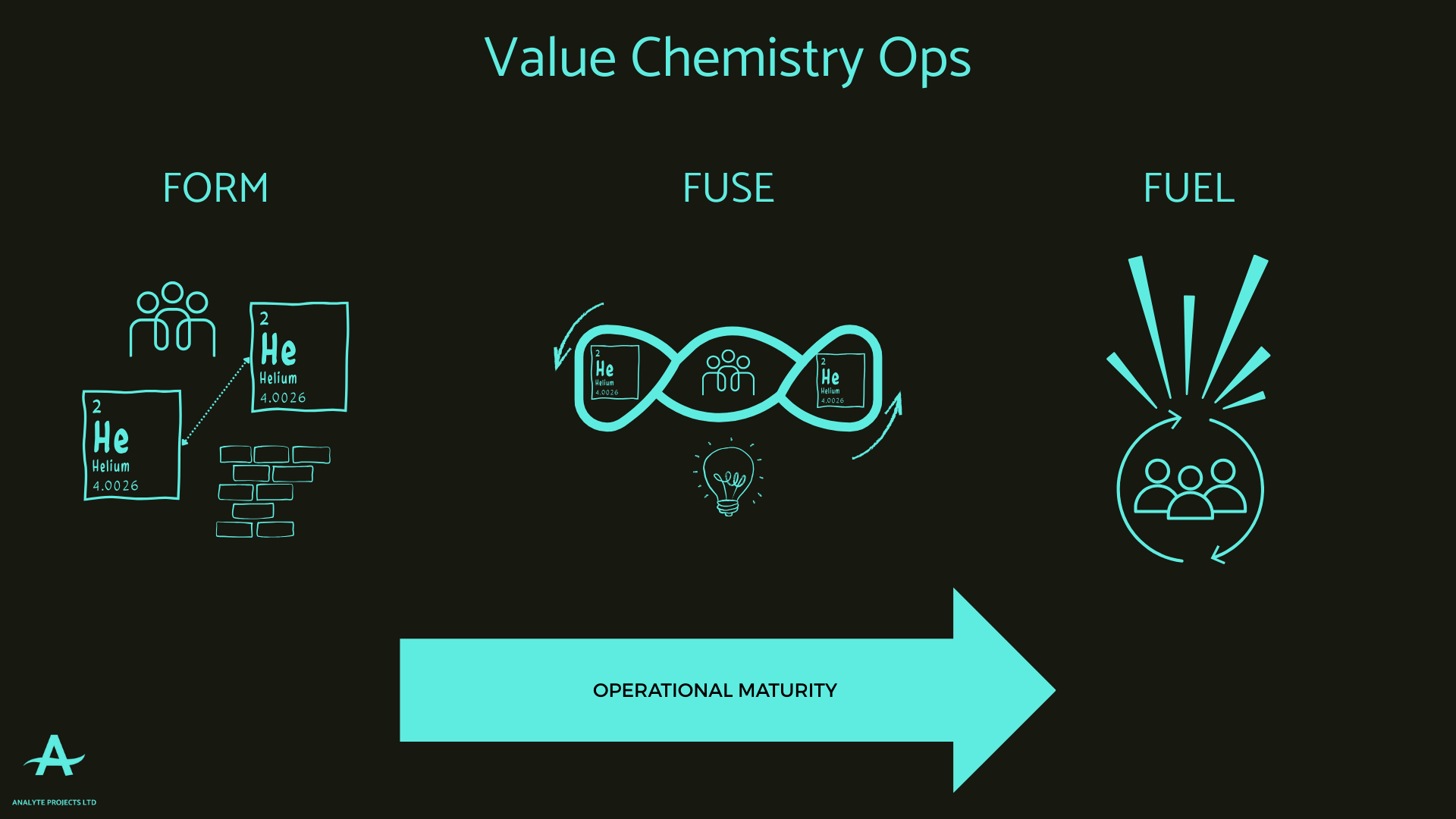
Fusion reactions are sometimes termed “the energy source of the Universe”. Their most common presentation is as the core energy powering the Sun and other stars. These reactions follow 3 phases that parallel organizational growth.
Form is the act of formation. In chemistry this is the attraction and assembly of elements into compounds, atoms into molecules, and the beginning of chemical integrity. Bonds are formed and the compound gets its base bonding energy that will drive reactivity. Organizational parallels are around establishing the core elements of a successful company: your early team, your cultural essence, your ways of working. Laying the foundation for future success in these early steps will dictate business survival. Getting some elements wrong will fail to generate the bonding energy required to sustain organizational chemistry.
Fuse is the act of fusion. This is the combining of atomic nuclei into a larger, heavier nucleus, and this has the potential to release enormous energy but is a tricky process with considerable risk. The most well understood example of fusion is the fusing of hydrogen atoms to form helium inside the sun. The energy released from this reaction we know as sunlight and heat which makes life on Earth possible. Organizational parallels include the “high-stakes” energy that permeates a company in this phase. Speed is increasing. Complexity is increasing. The need for formal processes arises. We’re squeezing a business idea into reality.
Fuel represents the final stage of a fusion reaction. These reactions, once started in the right environment will sustain themselves. Organizational parallels are readiness for scale. The business model is implemented and generating momentum. The team has the tools and supports they need to remain viable in the long-term. If we maintain this level of organizational chemistry, in theory the business could run forever unless it runs out of fuel.
Along the way we’ve designed your organization around value delivery. We’ve built a sustainable value delivery system. We’ve optimized human to human interactions and placed tools and supports around these to ensure they are consistent and repeatable. I call this “Value Chemistry Ops”.
Some people are curious about what happens after the Fuel stage.
There is a fourth stage potentially in a chemical reaction. I call it Fixation. In living tissues we halt the chemistry that might occur naturally to decay the tissue. This is done by stabilizing the proteins and fats in the tissue using a chemical additive to cross-link and preserve the tissue’s properties. Organizational parallels are the more traditional operations of a mature business. Standard operating procedures replace agile playbooks. Scale compartmentalizes people functionally and many organizations experience a loss of some of their initial energy. Success continues but it isn’t flashy. It isn’t high energy. And if the fixation phase isn’t just right, the organization will decay slowly over time. This phase is led by a permanent Ops position. Someone who specializes in optimizing and firming up the startup foundation we have laid for repeatability and longevity. Talent at this stage is experienced at balancing the forces that can decay operational energy. It is system maintenance, not system architecture.
This is also the phase I don’t stick around for. As this point arrives, your organization will be positioned to know the type of person you need to hire for this phase and we’ll equip that person for success together.
Every organization needs Value Chemistry Ops. But I meet many startups that have chosen a path with oversized operations or one where operations happen accidentally and fail to mature. Both of these journeys fail to cultivate the energy that successful fusion requires. The consequences of this are real and they inevitably result in the death of your idea.
If as you are reading this, you are realizing you aren’t on the path to successful fusion, don’t worry: chemistry is easily fixed by manipulating the environment and ingredients. Reach out and we will bring your idea to life the right way.